Jacksonville protests target local cooperation with ICE after recent joint operations and national enforcement controversy
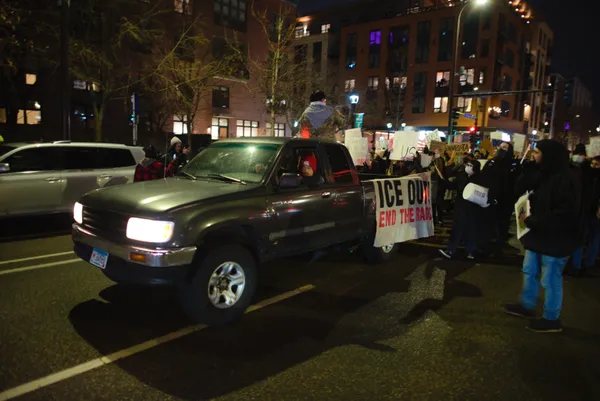
Demonstrations in Jacksonville highlight local concerns over immigration enforcement cooperation
Residents and immigration advocates in Jacksonville have held a series of public protests in January calling attention to the visible presence of federal immigration agents in the region and to agreements that allow local agencies to cooperate with U.S. Immigration and Customs Enforcement (ICE).
On Jan. 17, dozens of demonstrators gathered along Beach Boulevard on the Southside for what organizers described as an emergency action in response to recent joint law-enforcement operations involving ICE. The location was near where a widely shared video captured an arrest connected to a joint operation; the arrested woman later faced a charge alleging an attack on law enforcement during that operation.
Later, on Jan. 27, a larger downtown protest was held outside the federal courthouse. Participants focused on local policy and oversight, urging the Jacksonville Sheriff’s Office (JSO) and other Duval County agencies to end formal cooperation agreements with ICE. Protest organizers and participants argued that such partnerships increase the risk of broader immigration enforcement activity locally and can discourage immigrant residents from engaging with authorities.
What local ICE partnerships can involve
Federal law permits ICE to delegate certain immigration-enforcement functions to trained state and local officers through the 287(g) program. ICE describes three primary models:
- Jail Enforcement Model, focused on identifying and processing removable noncitizens in local custody with pending or active criminal charges.
- Task Force Model, which can allow limited immigration enforcement authority during routine police duties under ICE oversight.
- Warrant Service Officer program, which authorizes trained local officers to serve and execute ICE administrative warrants on people already in local custody.
Participation is formalized through a memorandum of agreement with ICE. The program has been a recurring flashpoint nationally because it can expand the immigration consequences of local arrests and deepen federal-local coordination in detention settings.
Broader context: protests beyond Jacksonville
Jacksonville’s demonstrations have unfolded amid wider national organizing that has included repeated protests in multiple U.S. cities over ICE enforcement activity and high-profile incidents tied to federal operations. Some northeast Florida demonstrations have explicitly referenced national events in their messaging, reflecting how local actions are being linked to broader debates about accountability, transparency, and the scope of immigration enforcement.
What’s next locally
The immediate policy question raised by protesters is whether local agencies should maintain, modify, or terminate formal cooperation mechanisms with ICE, including any 287(g) arrangements. For city and county leaders, the issue also intersects with public safety practices, detention operations, and community trust—particularly for residents who may be reluctant to report crimes or serve as witnesses if they fear immigration consequences.
Public demonstrations in January have centered on the role of local law enforcement in immigration enforcement, with organizers calling for clearer limits on cooperation and stronger local oversight.
Further developments are expected as organizers continue public actions and as local agencies face renewed questions about the structure and scope of their coordination with federal immigration authorities.